

Baptism doesn't rescue us from hell.
Baptism immerses us in agapic community.

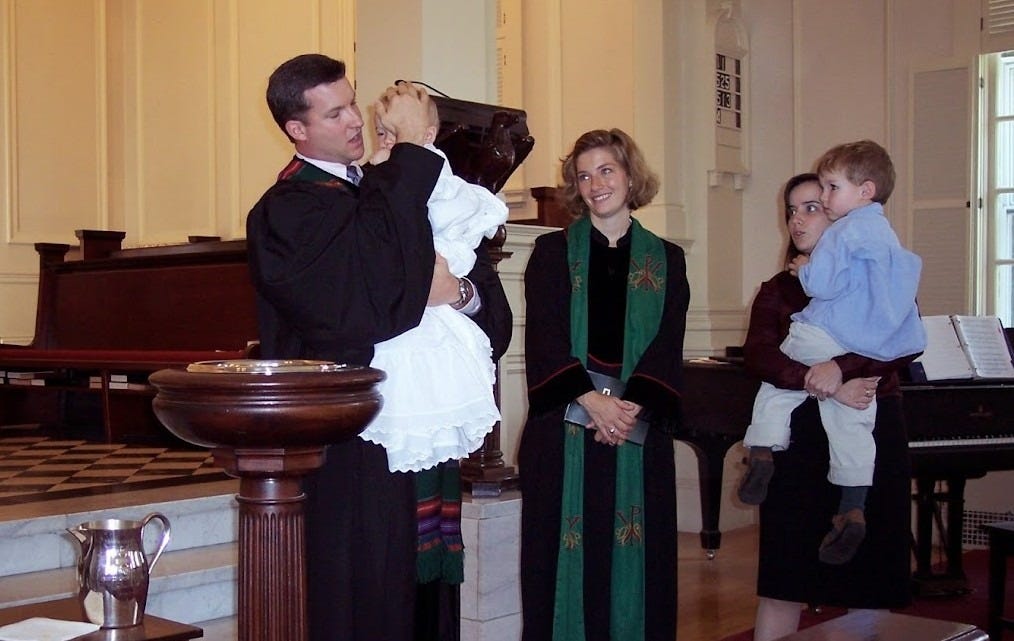
Baptism celebrates life itself as sacred. All rituals overflow language, including the language of ritual. Despite ritual’s resistance to the imperium of words, theology matters. Ritual may not be reducible to theological content, and it may not be translatable into language, but ritual still has cognitive content that language can suggest but not capture. That cognitive content will vary according to the participant, both in depth and meaning: bad interpretations produce impoverished ritual experience, while good interpretations produce enriched ritual experience.
And some interpretations of rituals are just plain old inadequate. My wife and I pastored a local Protestant church for many years. Since it was very much a local church, we ended up baptizing, marrying, and burying many Protestants, practicing or not, in the local community. (In pastoral parlance, we hatched them, matched them, and dispatched them.) Funerals were rarely problematic, but baptisms could get sketchy since, for many of the nonpracticing Protestants, they seemed to be more public performance than sacred rite, more about the after-party than the congregational commitment.
We would meet with parents prior to a child’s baptism, talk about the sacrament, and ask what it meant to the parents and extended family. We got a variety of answers, most of which were theologically subpar. Among the most common were: we need to baptize him now, before he gets too old and it looks funny; it’s not that big a deal to us, but his grandparents want him baptized; we haven’t had a family reunion in a while, and baptisms are more fun than funerals; I’m not sure if I believe this, but my great aunt is concerned that if he dies without being baptized he’ll go to hell.
Rarely did parents tell us that they wanted to raise their child in the love of God, and they wanted the help of a community in doing so, and baptism would seal that covenant.
At this point Abby or I would have a conversation with the parents. We would talk about baptism and what it means: In the sacrament of baptism, we utilize the everyday element of water to mark the holiness of life, thereby reminding ourselves of the sanctity of both. In baptism, the Holy Spirit Sophia proclaims that this child is predestined to God’s gracious covenant; they are beloved before being capable of love. The congregation, as priests of God to the child, promise to raise the child within the divine love, supporting the child unconditionally as they negotiate a highly conditional world. Thus, baptism begins a journey for all, in the hope that our faith will continue and deepen throughout life, in a community whose purpose, among many, is to discover and enjoy our shared humanity.
Baptism is by the community into the community. Such is our theology of baptism, but other communities have different theologies. This divergence came to a head in the archdiocese of Phoenix, where for over twenty years Rev. Andres Arango baptized children by saying, “We baptize you in the name of the Father and of the Son and of the Holy Spirit.” The prescribed formula is “I baptize you in the name of the Father and of the Son and of the Holy Spirit.”
This change in wording caused quite a kerfuffle. The local bishop, Thomas Olmsted, advised parishioners, “If you were baptized using the wrong words, that means your baptism is invalid, and you are not baptized. . . . The issue with using ‘We’ is that it is not the community that baptizes a person, rather, it is Christ, and Him alone, who presides at all of the sacraments, and so it is Christ Jesus who baptizes.” He went on to advise those invalidly baptized by Rev. Arango not to take communion until they had been validly baptized, although he did comfort them, “We can be assured that all who approached God, our Father, in good faith to receive the sacraments did not walk away empty-handed.”
Rev. Arango was not the first priest to baptize saying “we” instead of “I.” Among some quarters of the Roman Catholic priesthood, a preference had arisen for communitarian liturgy that engaged the whole congregation rather than emphasizing the activity of the priest alone. Enough priests were doing so that the Roman Catholic Church’s Congregation for the Doctrine of the Faith issued a prohibition against such communitarian liturgy in June 2020, declaring such baptisms invalid.
Earlier, some priests had adapted the baptismal liturgy, baptizing in the name of the Creator, Liberator, and Sustainer, or Creator, Redeemer, and Sanctifier, rather than Father, Son, and Holy Ghost. Theirs was an attempt to use gender-neutral language for God instead of exclusively masculine language for God, an innovation that the Congregation for the Doctrine of the Faith declared invalid in February 2008.
The theology we are developing here dovetails with the communitarian language of Rev. Arango as well as the gender-neutral language of the other priestly reformers. The primary purpose of ritual is pastoral—to care for persons in their journey through life. Since pastoral needs change with pastoral circumstances, the performance of ritual need not hew closely to any preexisting pattern. We must adapt rituals over time, because the patriarchal formulations of yesteryear may ring oppressive in our egalitarian, universalist minds.
Moreover, the agapic love communicated by the ritual, not the precise wording, makes it effective. We don’t have to “get it right,” but we hope that it “works,” as does medicine on a disease. The feelings a ritual produces, the understanding it confers, and the activity it encourages render the ritual successful or unsuccessful. Therefore, the best rituals are indeed communitarian expressions of existential solidarity. These rituals recognize our fundamental unity within a creative power coursing through the universe, whose greatest desire is to accompany us.
Religious ritual should communicate equality. Because nonbinary persons, women, and men are all equally made in the image of God, hence equally divine, liturgical language should be gender-neutral or gender-inclusive. Exclusively masculine language for God ratifies patriarchy and resists the divinely intended equality. Recognizing that the Bible uses primarily masculine language for God, the church must emphasize those texts that use feminine language for God, thereby advancing feminism—the belief that all genders are equal in talents, rights, and responsibilities. It must also emphasize those texts that refer to a gender-transcendent God, thereby explicitly including nonbinary persons within the divine image.
Such inclusiveness is not a dream or even a plan; it is happening already, in many churches around the world. At Grace Community Boston, utilizing the innovation of Rev. James F. Kay for Riverside Church, we baptize “In the name of the Father, the Son, and the Holy Spirit; one God, Mother of us all.” We begin the Lord’s Prayer with “Our Beloved, who art in heaven . . .” And we conceptualize Sophia the Holy Spirit as female in story, liturgy, and song, providing all genders with a feminine divine. Christian theology need not be patriarchal, and Christian liturgy need not be patriarchal. Both can be egalitarian, and they are becoming so, thank God. (adapted from Jon Paul Sydnor, The Great Open Dance: A Progressive Christian Theology, pages 234–237)
*****
For further reading, please see:
Lines, Caleb J. Awakened: A 52-Week Progressive Christian Devotional. Des Peres, Missouri: Chalice Press, 2024.
Miralles, Antonio. “A New Response of the Congregation for the Doctrine of the Faith on the Validity of Baptism.” Vatican, Feb. 1, 2008. https://www.vatican.va/roman_curia/congregations/cfaith/documents/rc_con_cfaith_doc_20080201_validity-baptism-miralles_en.html.
Always appreciate drawing attention to Holy Spirit Sophia. And can always count on the Congregation of the Doctrine of Faith to take the joy out.
Great thoughts!